
The One-Sentence Rule, and Why It Doesn't Always Hold
A garage door spring almost never fails without weeks or months of warning signs first — the coils stretch, the metal fatigues, the door gets harder to move, and all of that shows up before the final break. The exceptions are worth knowing, though. A spring that's been quietly corroding from the inside out — common here thanks to salt air drifting up from the coast and the humidity that never really lets up — can snap with almost no warning because the rust has already done the damage where you can't see it. The same goes for springs that go through extra heat-cycling during a run of afternoon downpours and sudden temperature swings; the metal expands and contracts more than it was built for, and a fatigue crack that was slowly forming can let go all at once. So treat this checklist as your early-warning system, not a guarantee — and if you ever see a spring that looks fine but the door still feels wrong, trust the door.
Walk the Garage: A Spring Checklist
1. Look at the Gap in the Coils (Torsion Springs)
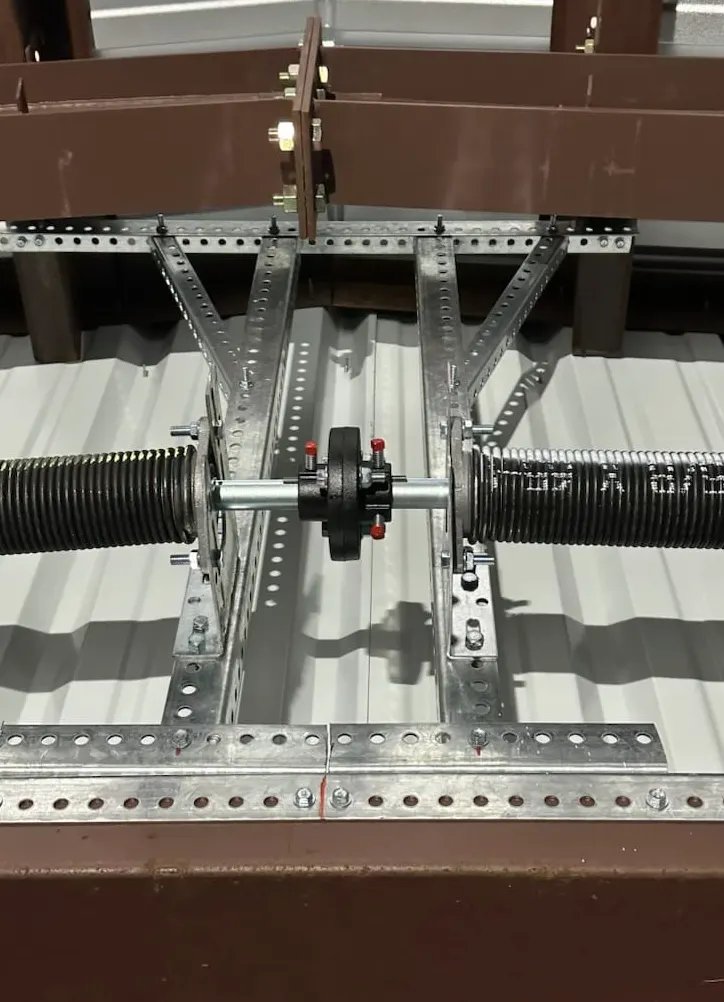
With the door fully closed, look at the torsion spring mounted above the door on its shaft. A healthy spring sits with its coils close together, evenly spaced along the shaft. If you see a visible gap — a stretched-out section where coils have separated — that's metal fatigue setting in. The spring is losing its tension and working harder than it should to do the same job.
2. Run the Manual Lift Test
Disconnect the opener (pull the red emergency release cord) and lift the door by hand about halfway. A door with healthy springs should stay roughly where you put it, or drift down slowly. If it crashes down on its own or feels noticeably heavier than it used to, the springs have lost tension and are no longer carrying their share of the door's weight.
3. Check for Uneven Movement
Watch the door as it opens and closes. One side dropping lower than the other, or the door tilting as it travels, usually means one spring is still strong while its partner has weakened. This is especially common with torsion systems, since the two springs rarely wear out at exactly the same rate.
4. Inspect Extension Springs for Stretch and Gaps
If your door uses extension springs (the long springs running along the horizontal tracks instead of above the door), open the door fully and look at the spring length. A spring that's visibly elongated compared to its relaxed, closed-door length has lost elasticity. You're also checking for any section where the coils have pulled apart into a visible gap — a sign the spring is close to giving out.
5. Look for Rust, Pitting, and Discoloration
Run your eyes (not your bare hand) along the full length of every spring. Rust spots, flaking, or a rough pitted texture mean moisture has been working on the metal — not unusual in this climate, where humidity and salt air both accelerate corrosion. Pitted metal is weaker metal, even if the spring still looks like it's holding tension.
6. Listen for New Noises
A spring on its way out often announces itself. Listen for creaking or groaning as the door travels, a popping sound at the top or bottom of the cycle, or a metallic scraping that wasn't there before. These sounds usually mean the coils are rubbing against each other in places they shouldn't, or the spring is flexing unevenly as it loses strength.
7. Watch How Hard the Opener Works
Your opener motor is designed to assist a properly sprung door, not to lift the whole weight by itself. If you notice the opener straining, slowing down partway through the cycle, reversing unexpectedly, or making a labored humming sound, the springs are likely no longer pulling their weight — literally. This also shortens the opener's lifespan, since the motor is doing a job it wasn't built for.
8. Check Cables for Fraying or Slack
Extension spring systems pair with lift cables, and torsion systems use cables too. Frayed strands, visible kinks, or cable that looks loose and slack when the door is down are signs the whole lift system is under uneven stress — often because a spring nearby has already started to fail.
9. Confirm Safety Cables Are Still in Place
If you have extension springs, there should be a safety cable running through the center of each one. These cables keep a failed spring from becoming a projectile if it snaps. If yours are missing, frayed, or were never installed, that's worth fixing regardless of how the springs themselves look.
10. Count the Years and the Cycles
Most springs are rated for a number of open-close cycles rather than a calendar age, but as a rough guide, many residential springs last somewhere in the 7-to-9-year range under normal use. Doors that open and close more often than average — including homes where the garage gets used as a storm shelter staging area during hurricane season, or where storm shutters mean extra trips in and out — will wear through that cycle count faster.
When to Call Mayo Door & Opener
If you're seeing more than one or two items on this list, it's time to get a second set of eyes on the system before you're stuck with a door that won't open at all. Our Garage Door Spring Repair service covers both torsion and extension setups — we'll check spring tension, coil condition, and cable integrity, and replace what's wearing out before it fails on its own terms. If cables, rollers, or hardware are showing wear alongside the springs, our Cable & Roller Replacement service handles that in the same visit, since a spring rarely fails in isolation.
If you're anywhere in Mayo, Perry, Live Oak, Cross City, Branford, Trenton, Old Town, or Steinhatchee and your garage door is giving you any of the warning signs above, call Mayo Door & Opener before it turns into a jammed door and a missed morning. We'll come out, check the springs properly, and tell you straight whether it's a repair or a replacement.